What happened
- Ten researchers, with Yan, Wang, Li and Zhao among the authors, published on 5 November 2026 in Nature Communications a method for making very strong crystalline hydrogels.
- Hydrogels are polymer networks that retain a lot of water. For demanding engineering uses they need high mechanical strength and environmental stability.
- Crystalline hydrogels are promising because their crystallites act as physical crosslinks and energy dissipators, but precise control over their crystalline architecture was underexplored.
- The team proposes a strategy called ASGS, inspired by industrial thermoplastic processing.
Why it matters
- A material that keeps its strength fully hydrated and underwater could serve for load-bearing structures in marine or harsh environments.
- A hydrogel’s strength is usually at odds with its water content. This work seeks to break that relationship with high, oriented crystallinity.
- The method is put forward as a scalable paradigm for making strong, stable crystalline hydrogels.
The number
160.0 MPa. That is the hydrogel’s tensile strength in the fully hydrated state, with a modulus of 746.0 MPa and a fracture energy of 26.4 kJ per square metre. The corresponding plastic, already dry, reaches 414.2 MPa while retaining flexibility.
Context
ASGS stands for three stages. The first is alkali-induced chain activation (A), which gives moderate initial crystallinity with refined nascent crystallites. The second is ultra-stretching (S), which builds a highly oriented chain network. The third is densification with a glycerol and seawater mixture (GS), which takes crystallinity to its maximum and leaves the crystallites highly oriented.
The logic is that of a thermoplastic: the material is activated, stretched to align the chains and then compacted. Applying that industrial recipe to a hydrogel is the central idea of the work.
These are laboratory results on small samples with one specific polymer. The abstract reports neither long-term durability nor tests under real marine conditions, although it mentions underwater use as a target.
At Mamífero we follow high-performance materials. We reported that a soft microneedle patch measures glucose, pH and temperature and that PolyU presented an alloy that withstands cryogenic temperatures. Also that a one-metre titanium single crystal was 3D-printed and that a sleeve with tactile pixel fibres shows video.
What’s next
- Testing the material in seawater over long periods is the next step.
- Scaling the process to larger pieces will show whether the properties hold.
- The recipe can be tried with other crystallizable polymers.
Bottom line
A hydrogel is usually soft and fragile. This one is far less so, and the reason is that its crystals all ended up facing the same way.
Sources
- Yan, Wang, Li, Zhao et al., “Strong hydrogels through precisely oriented crystallization regulation”, Nature Communications, 5 November 2026, DOI 10.1038/s41467-026-79005-7. This note is based on the paper’s abstract.
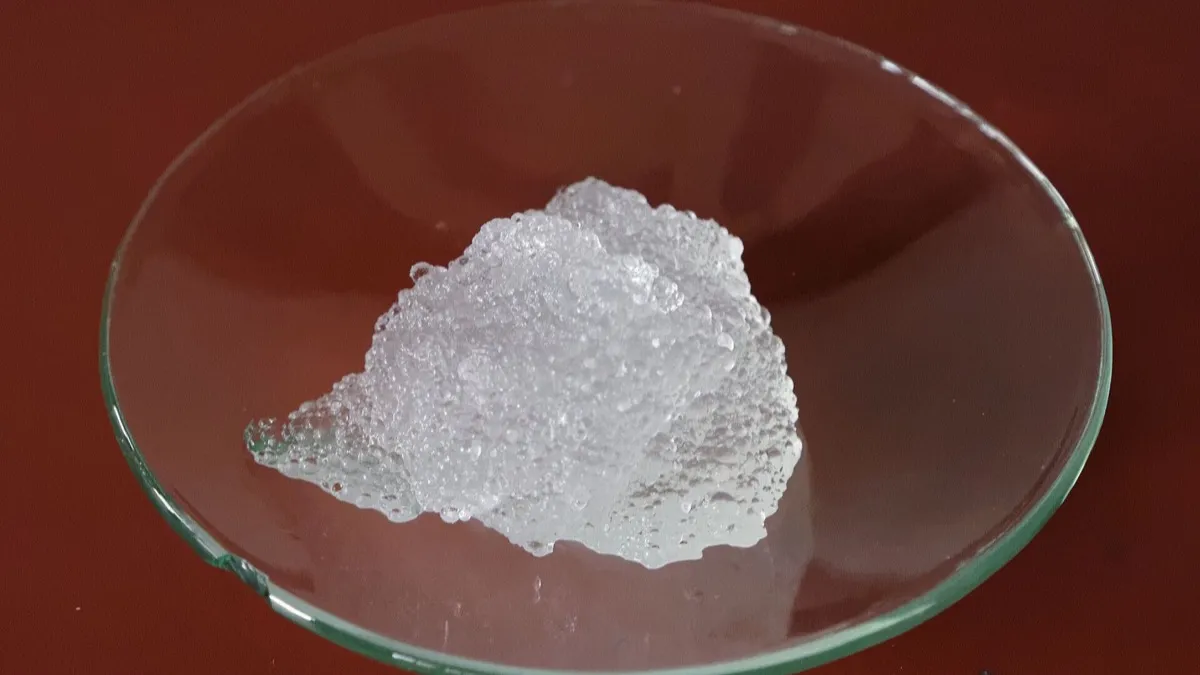
- Cover image: Petra Klawikowski, CC BY-SA 3.0, via Wikimedia Commons
Edited by Rodrigo Cornejo. How we select and verify: who writes these notes.