What happened
- On October 23, 2026, Scientific Reports published a survey of the air in Pozzuoli, the city that sits on the Campi Flegrei caldera near Naples.
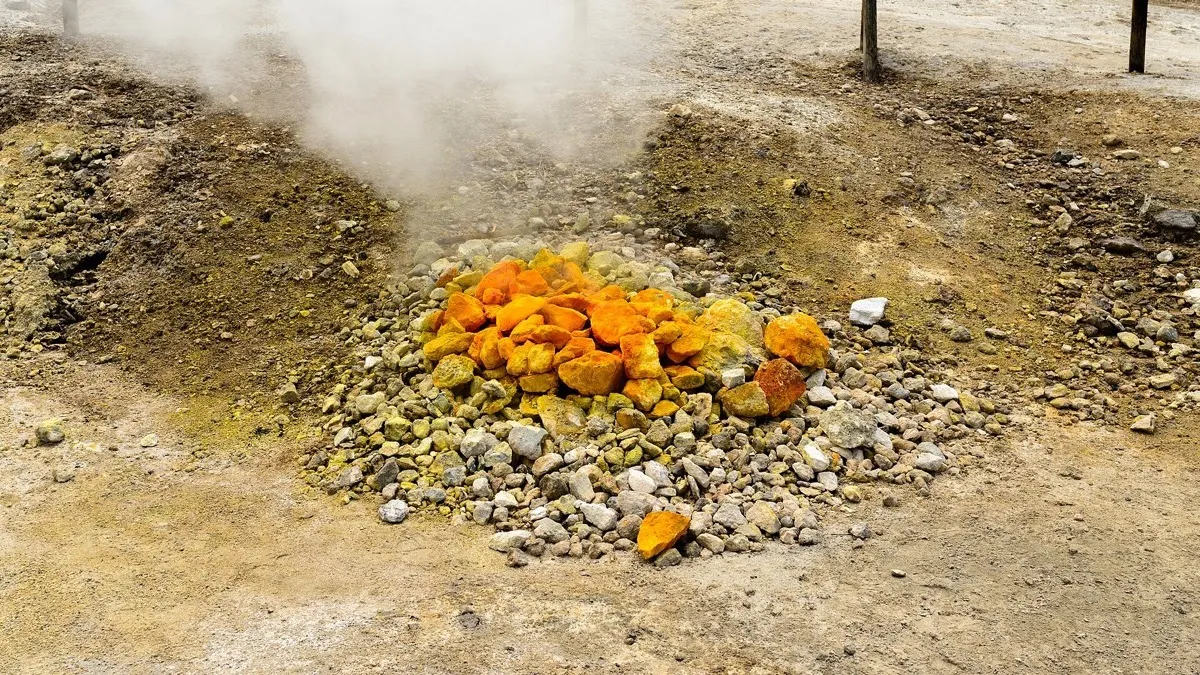
- The work, by Italy’s National Institute of Geophysics and Volcanology, with offices in Naples and Palermo, was prompted by reports of high CO₂ inside homes in the city.
- With a portable laser spectrophotometer, the team measured carbon and oxygen isotopes in CO₂, along with ammonia and water vapour, along a route through the city.
- The CO₂ in the air showed signatures consistent with three sources: soil degassing, volcanic CO₂ dispersing from the Solfatara and fossil fuel combustion.
Why it matters
- CO₂ concentrations barely varied from one point to another, so only the isotopic signature could tell the origin of the gas apart.
- The air showed a measurable enrichment in carbon-13 that simple dilution does not explain, but mixing with a heavier geological CO₂ does.
- For a population living with the volcano, separating volcanic from urban gas makes it easier to track exposure.
The number
5,000 tonnes a day. CO₂ released by the Solfatara area since bradyseismic activity at Campi Flegrei resumed in 2005, according to the paper.
Context
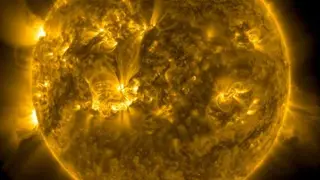
Bradyseism is the slow rise and fall of the ground in the caldera, accompanied by earthquakes. The study estimates a δ13C value close to −1.8 per mil for the geological CO₂. Water vapour varied with distance from the shore and ammonia reflected human influence in densely populated areas. Along the route, CO₂ in the air stayed well below short-term exposure limits, although those thresholds are meant mainly for indoor settings. Other natural phenomena with measurable effects on people appear in the 2025 solar storm and radiation on flights.
What’s next
- The authors present combined carbon and oxygen isotope measurement as a tool to monitor volcanic sources in urban areas.
- The indoor CO₂ reports that prompted the survey remain the next front for measurement.
Bottom line
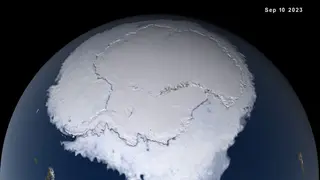
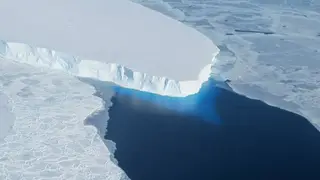
A city’s air can carry the chemical signature of the volcano beneath it. Earth sciences track other slow changes, such as the Baffin ice cap that was regrowing towards an ice age, the winter maximum of Antarctic sea ice in 2026 and NASA’s model for Thwaites Glacier.
Sources
- Scientific Reports — Tracking spatial variations of CO2 isotopologues, NH3 and H2O in urban air: a case study from the Campi Flegrei Caldera (October 23, 2026)
- Cover image: Norbert Nagel, CC BY-SA 3.0, via Wikimedia Commons
Edited by Rodrigo Cornejo. How we select and verify: who writes these notes.