What happened
- Columbia University released a theoretical study identifying a process in Einstein’s equations called “gravitational reconnection.” ScienceDaily reproduced it on November 8, 2026.
- It holds that structures within gravitational fields can break apart and reconnect, and that in the process energy is transferred from gravity to matter.
- The authors are Luca Comisso, of Columbia, and Felipe A. Asenjo, of Universidad Adolfo Ibáñez in Chile.
- The work appeared in Physical Review D and, with Maricarmen A. Winkler, in Physical Review Letters (both in 2026).
Why it matters
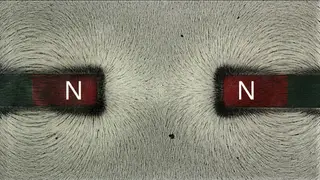
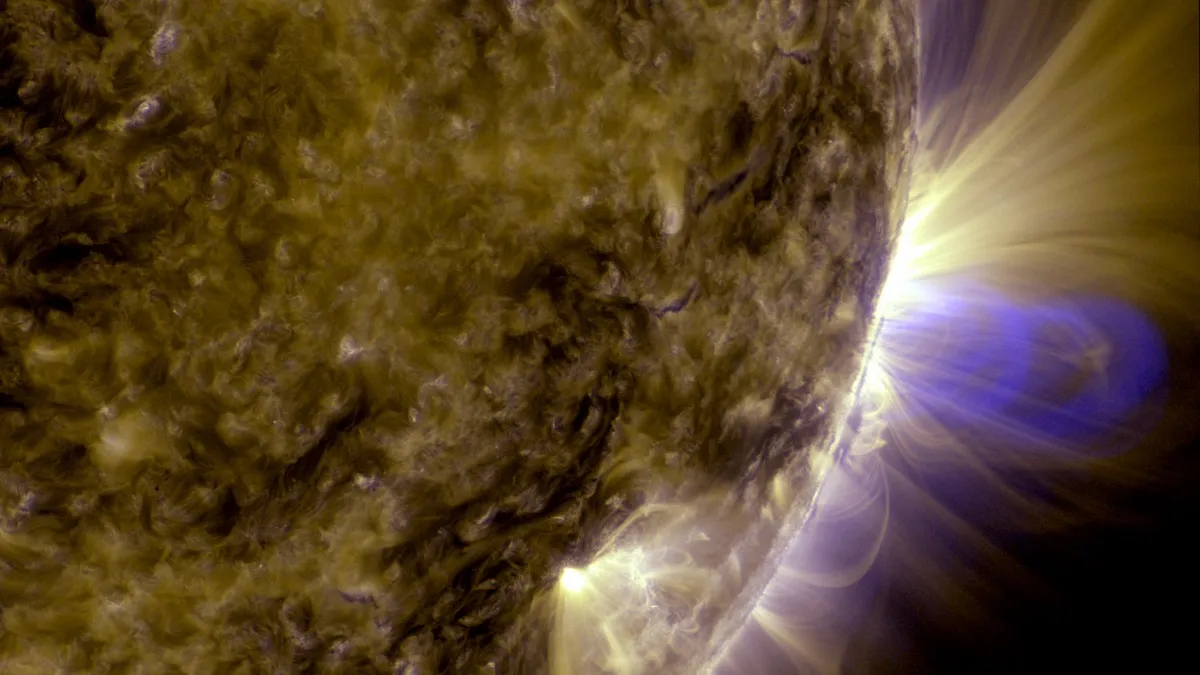
Magnetic reconnection occurs in a plasma, a gas of charged particles: magnetic field lines break and join in a different way, releasing energy. That mechanism powers solar flares and is among the main ways energy is released in the universe.
Comisso and Asenjo found that the gravitational field could undergo an analogous transformation. That could offer clues about gravity under extreme conditions, such as black hole collisions, where even computer simulations are hard to interpret.
The number
Four dimensions. Gravity operates in Einstein’s spacetime, with three dimensions of space and one of time, which makes its mathematical structure different from an ordinary magnetic field. The authors bridged that difference by looking at the equations from another mathematical perspective.
Context
According to Comisso, magnetic reconnection is when field lines, in some specific configuration, break and reattach in a different one. “When they break and reconnect, they release energy,” he says. That energy passes from the field to the plasma particles and produces explosive events.
The approach reveals a resemblance between gravity and the behavior of charged gases, and could help uncover rules governing gravitational fields. It is a theoretical, mathematical result, with no observation confirming it. There is no measurement of gravitational reconnection in a real astrophysical phenomenon, and that is what is missing to verify it.
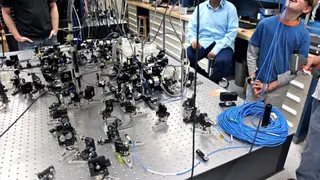
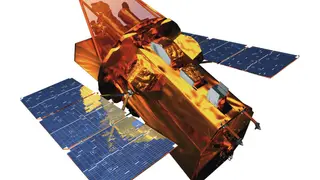
At Mamífero we have followed physics and astronomy research. A boundary between space and time slows ultrafast electronics, Webb measured methane in 3I/ATLAS with 13 times more deuterium than comet 67P’s, NASA’s Swift telescope falls to Earth after almost 22 years and SLAC confirms altermagnetism in a MnTe crystal.
What’s next
- The authors hope to use the analogy to study black hole collisions.
- Other groups will be able to look for observable signatures of gravitational reconnection.
- Numerical simulations would have to reproduce the process to confirm it.
Bottom line
The study measures nothing new in the sky but uncovers a structure within equations more than a century old. Its value will be seen if simulations or observations show the process.
Sources
- ScienceDaily, “Einstein’s equations reveal how gravity could break, reconnect, and release energy”, November 8, 2026, link. Reproduces the Columbia University press release.
- Comisso, L., Asenjo, F. A., “Reconnection of gravitational fields”, Physical Review D 114(8), 2026, DOI 10.1103/lmqy-pf9k; Asenjo, F. A., Winkler, M. A., Comisso, L., “Frozen-In Gravitational Fields”, Physical Review Letters 136(16), 2026, DOI 10.1103/6c4q-kx6f.
- Cover image: NASA/Goddard Space Flight Center/SDO, Public domain, via Wikimedia Commons
Edited by Rodrigo Cornejo. How we select and verify: who writes these notes.