What happened
- Six researchers, with Qiu, Zheng, Yang and Hua among the authors, published on 4 November 2026 in PNAS a study of knot dynamics observed in granular chains.
- Knots abound in long chains, from DNA and proteins to everyday strings, but watching them move in detail is difficult.
- They used bead chains on vibrating platforms, a system that allows what the knot does to be filmed directly.
- They observed that the knot core tightens spontaneously, and that the behaviour repeats across different knot types.
Why it matters
- A tight knot changes how a chain moves and breaks, which matters in materials as much as in molecular biology.
- The experiment turns a hard-to-observe problem into something visible and measurable, with a relatively simple setup.
- The authors connect the result to topoisomerase-mediated DNA unknotting, the enzymes that resolve tangles in the cell.
The number
Entropy, not force. The explanation they propose is knot-tube theory: segments confined within the core lose entropy and tend to escape to gain conformational freedom, which leaves the knot tighter.
Context
The system has an interesting theoretical wrinkle. Driven granular chains are not in thermodynamic equilibrium; even so, the steady-state knot-size statistics are approximately captured by equilibrium statistical mechanics and Monte Carlo simulations.
Analysing state-transition probabilities and time-reversal asymmetry, the authors find signs of a weak violation of detailed balance when the dynamics are projected onto the knot-size coordinate. That is, the system looks much like one in equilibrium, but not entirely.
At Mamífero we follow the physics of the everyday and the molecular. We reported that a helicene turns like an Archimedes screw under current and that a microscope tip flips molecules with less energy than the barrier. Also that a micropillar array separates oil and water with a gas film and that a carbon ribbon of pentagons and heptagons conducts like a metal.
What’s next
- The setup allows other knot types and other vibration conditions to be studied.
- The DNA connection is raised as a hypothesis, not demonstrated in the biological system.
- Measuring how far such a system departs from equilibrium remains an open question.
Bottom line
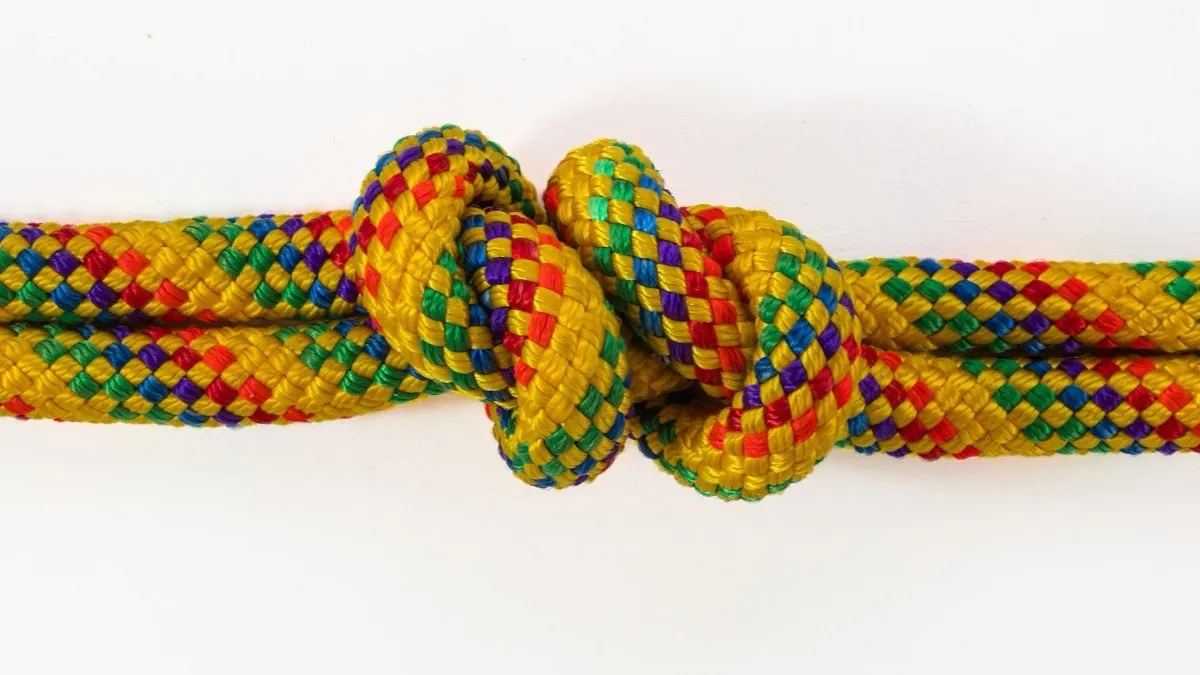
A knot that tightens on its own looks like bad luck with headphones. It turns out there is a physical tendency behind it: trapped segments seek room, and the knot shrinks.
Sources
- Qiu, Zheng, Yang, Hua et al., “Entropic tightening of knots in granular chains under vibration”, PNAS, 4 November 2026, DOI 10.1073/pnas.2615990123. This note is based on the paper’s abstract.
- Cover image: Friedrich Haag, CC BY-SA 4.0, via Wikimedia Commons
Edited by Rodrigo Cornejo. How we select and verify: who writes these notes.