What happened
- A team from the University of Science and Technology of China, Hefei National Laboratory and Nankai University reported in Nature on October 28, 2026 the synthesis of carbon nanoribbons made of rings of five and seven atoms, instead of graphene’s hexagons.
- This form of carbon, called pentaheptite, had been predicted in theory to be metallic, but had not been made into atomically precise ribbons.
- The researchers obtained two types. Both have a central chain of heptagons flanked by chains of pentagons: in the first, CPHN 1, the side chains share the same orientation; in the second, CPHN 2, they differ.
- CPHN 1 turned out to be an intrinsic metal and CPHN 2 a semiconductor with a narrow band gap.
Why it matters
- Carbon electronics needs both semiconductors and conductors. Semiconducting graphene nanoribbons are already made with atomic precision; metallic wires of the same kind to connect them were missing.
- CPHN 1 showed near-ballistic conduction, close to one conductance quantum, comparable to metallic carbon nanotubes. That means electrons cross it with almost no collisions.
- The fact that a small difference in chain orientation switches the material from metal to semiconductor opens the possibility of designing both components with the same chemistry.
- The authors present these ribbons as possible electrodes and interconnects in an all-carbon electronics.
The number
1 conductance quantum. That is the value CPHN 1’s conduction approaches, the limit quantum physics sets for a lossless one-dimensional channel.
Context
Graphene is a sheet of carbon with six-atom rings. When cut into very narrow ribbons, its electrical properties depend on the width and the shape of the edge. Until now, metallic nanoribbons were obtained through band engineering in graphene structures, not from carbon allotropes without hexagons.
The method is hierarchical and takes place on a surface. First, polycyclooctadiene chains are synthesized, then turned into well-aligned polypentalene chains. Finally, those chains are fused side by side into the flat ribbon.
That step-by-step control is what allows choosing the orientation of the side chains and, with it, the type of material that results.
What’s next
- The synthesis takes place on metal surfaces under lab conditions; bringing it to real devices will require transferring the ribbons to other substrates.
- Integrating metallic and semiconducting ribbons in the same carbon circuit is the step the authors leave on the table.
Bottom line
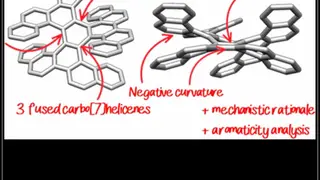
Precision chemistry on surfaces is advancing in parallel: a microscope tip flips molecules with less energy than the barrier and a helicene turns like an Archimedes screw with current. In conduction, Columbia trapped electron waves in a metal, and in metals at another scale, researchers 3D printed a one-meter single crystal of titanium.
Sources
- Nature — Narrow carbon pentaheptite nanoribbon as a covalent metal (Huang et al., October 28, 2026)
- Cover image: Rama, CC BY-SA 3.0 fr, via Wikimedia Commons
Edited by Rodrigo Cornejo. How we select and verify: who writes these notes.