What happened
- A team of 24 researchers from Roche’s Innovation Center in China published on 3 November 2026 in PNAS the characterisation of RO7783903, abbreviated RO3903, an inhibitor of the KRAS G12C mutation.
- KRAS G12C is a common mutation in tumours. First-generation drugs against it, such as sotorasib and adagrasib, lose effect because the cell reactivates KRAS into its active, GTP-bound form, which those drugs cannot reach.
- RO3903 is a “tricomplex” inhibitor that binds covalently to the active (ON) form of KRAS G12C.
- The authors systematically compared clinical and investigational drugs, including sotorasib, adagrasib, divarasib and elironrasib, with their own compound.
Why it matters
- Resistance limits how long responses to current KRAS G12C inhibitors last.
- According to the study, RO3903 and elironrasib act faster than the cycle by which the cell switches KRAS between its active and inactive forms. That lets them withstand strong receptor tyrosine kinase stimulation and overcome secondary KRAS mutations that cause clinical resistance to drugs targeting the inactive form.
- RO3903 inhibited tumour growth in a dose-dependent way across several preclinical models, including a model of a tumour inside the skull.
The number
4. That is the number of clinical and investigational KRAS G12C drugs RO3903 was compared against: sotorasib, adagrasib, divarasib and elironrasib.
Context
The authors also tested combinations. RO3903 showed synergistic efficacy with inhibitors of the inactive form of KRAS G12C, of YAP-TEAD, of EGFR and MET, and of FAK. Also with immunotherapies: an anti-PD1 antibody and an anti-PD1 and anti-VEGF bispecific antibody.
The company presents the compound as a research tool and a possible partner for combination strategies that achieve lasting tumour shrinkage. Its potency, how fast it reaches its target and its effect on brain tumours are the main arguments. All results are preclinical.
At Mamífero we follow cancer treatments. We reported that a KRAS vaccine for pancreatic cancer missed its primary goal, that an antibody that activates two groups of T cells achieved responses in cold tumours and that modified transfer RNAs repair the p53 gene and shrink tumours. In neurology, Alzheimer-like changes in 14% of ALS patients were linked to shorter survival.
What’s next
- RO3903 will need safety studies before any trial in people.
- Combinations with immunotherapy and other inhibitors are the path the company proposes to explore.
- The effect in the intracranial model raises the question of brain metastases with KRAS G12C.
Bottom line
Drugs against KRAS G12C work until the cell sidesteps them. RO3903 tries to get ahead of that reactivation by targeting the gene’s active form, and in mice it succeeds; whether it does in patients remains to be seen.
Sources
- Yao, X., Wang, S., Xie, J. et al., “Rapid target engagement of KRAS G12C tricomplex inhibitor RO3903 overcomes resistance and drives durable tumor regression”, PNAS, 3 November 2026, DOI 10.1073/pnas.2621263123. This note is based on the paper’s abstract.
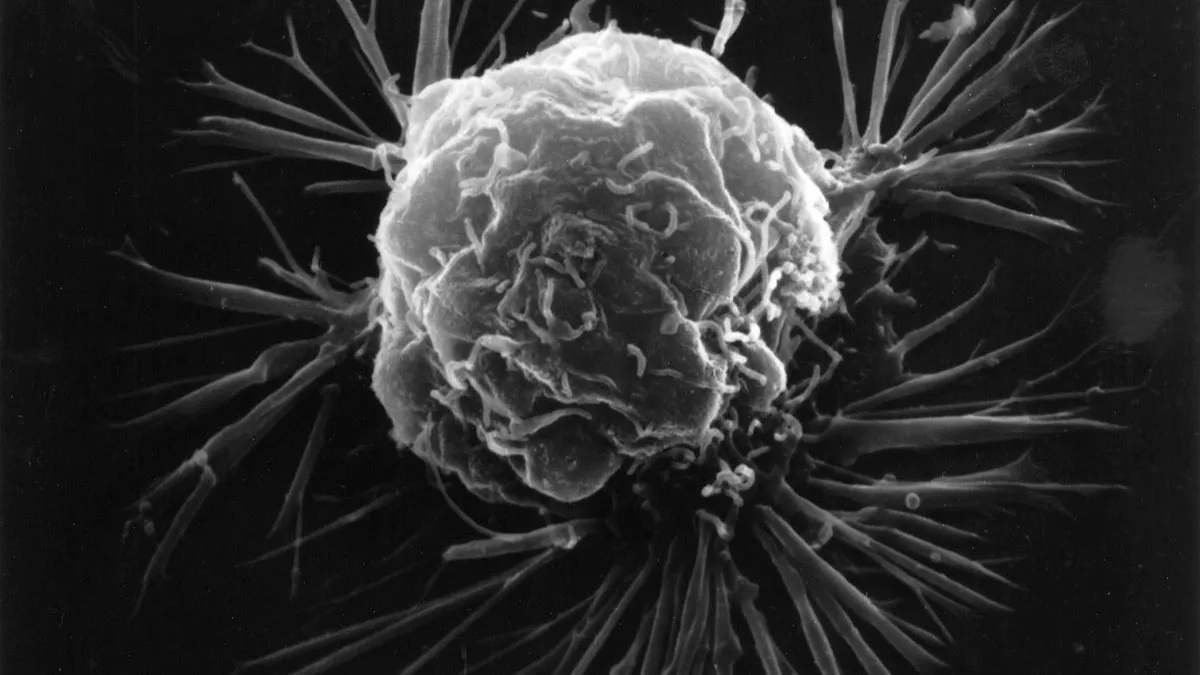
- Cover image: autor desconocido, National Cancer Institute, public domain, via Wikimedia Commons
Edited by Rodrigo Cornejo. How we select and verify: who writes these notes.