What happened
- An international team led by Alexander Trokhimovskiy identified unusual hydrogen chloride concentrations above fractures in the Alba Mons volcanic region on Mars.
- The study was published in Science Advances and ScienceDaily circulated it on 7 November 2026.
- Researchers believe the gas could come from hot magma underground, escaping through surface cracks.
- ESA’s ExoMars Trace Gas Orbiter (TGO) first detected hydrogen chloride in the Martian atmosphere in findings from 2021.
- The team saw anomalous concentrations in early northern-hemisphere summer.
- Daniel Mège of the Space Research Centre of the Polish Academy of Sciences said Mars kept enough internal heat to sustain volcanic activity until recently, and possibly still does.
Why it matters
Mars is often described as geologically inactive. If dormant volcanoes are confirmed to release gases, the picture changes: the interior would still hold heat, and the planet would have processes shaping its atmosphere and history. On Earth hydrogen chloride typically escapes through openings tied to magma, so finding it over volcanic fractures suggests a similar origin, though it does not prove it.
The number
2021. The year TGO first reported hydrogen chloride in Mars’s atmosphere; the new work ties it to a specific region.
Context
The authors point to a spatial correlation between gas and fractures, and a seasonal pattern. The text read does not rule out other explanations, such as reactions with surface dust or salts, so the volcanic idea is an interpretation, not settled fact. Confirmation will come from more orbiter observations and other missions. Related coverage: A physical model of the Webb telescope multiplies its sensitivity up to 15 times, The Sun may have stripped between 1.7 and 5.2 meters of surface from interstellar comet 3I/ATLAS, Japan launches the MMX probe to Mars to bring back samples from the moon Phobos, A black hole disk puffs up and casts a shadow on itself earlier than expected.
Measuring a gas in another planet’s atmosphere is done from orbit by watching how sunlight is absorbed at different wavelengths as it passes through the air. The technique detects very small amounts but does not see their origin directly. That is why the link to terrain fractures and to a season is the central argument: if the gas were an artifact of another source, it should not concentrate over a specific place.
What’s next
- New orbiter observations can confirm whether the gas reappears in the same place and season.
- Mars interior models must explain heat sufficient to sustain activity.
- Gas analysis by other missions would give a second line of evidence.
Bottom line
A scarce gas can change the picture of a planet. If the finding holds, Mars goes from dead world to one on pause.
Sources
- ScienceDaily, “Mysterious gas leaks suggest Mars may still be volcanically alive”, 7 November 2026, on a Science Advances study. The original paper was not read.
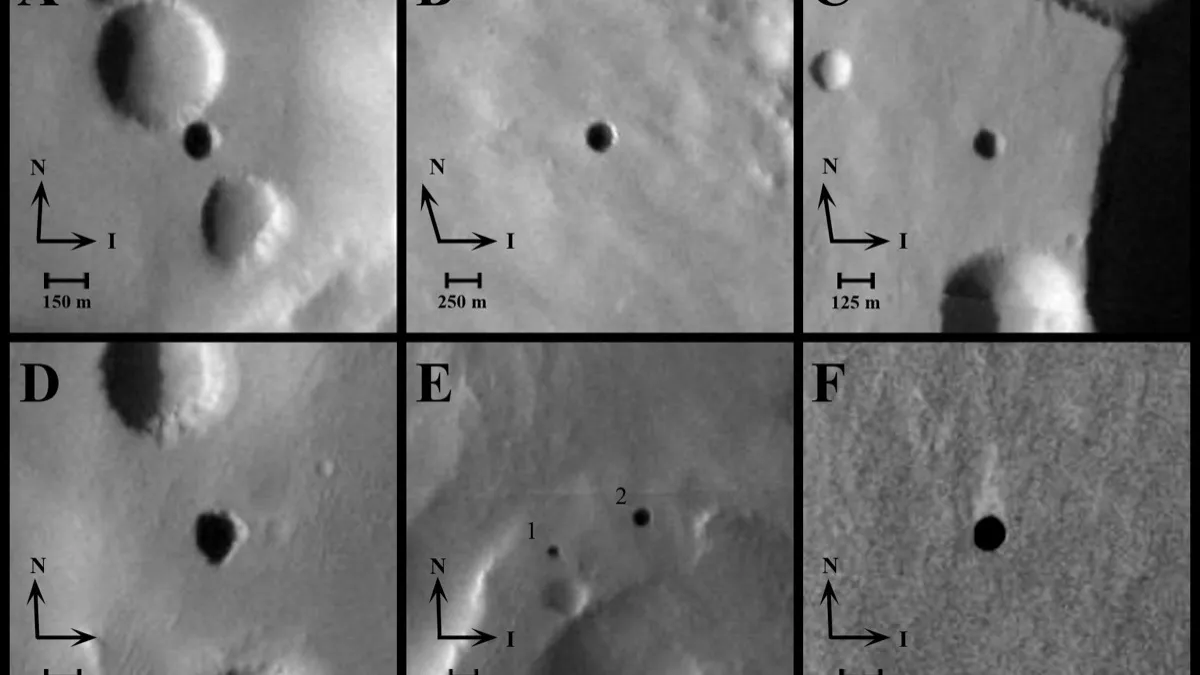
- Cover image: NASA JPL USGS ASU NAU, Public domain, via Wikimedia Commons
Edited by Rodrigo Cornejo. How we select and verify: who writes these notes.