What happened
- Seven researchers, among them Ferrer-Chavez, Wang, Bouman and Freeman, published on 4 November 2026 in Nature a method for subtracting a star’s light from direct images of exoplanets. Ars Technica explained it the following day.
- The method is called FLIP and starts from a physical model of NIRCam, the near-infrared camera on the James Webb Space Telescope.
- It optimizes millions of model parameters through automatic differentiation, the same mathematical tool used to train neural networks, although what is tuned here is a model of the instrument.
- They tested it on real observations of three stars: HIP 65426, 51 Eridani and TYC 5899.
Why it matters
- To photograph a planet, its star’s glare has to be switched off. The usual methods subtract reference images, but the telescope changes slightly between one exposure and the next.
- Modelling those variations gets more out of every hour of observation, without building new instruments.
- The authors suggest the approach could relax the stability requirements planned for future observatories, such as Roman and the Habitable Worlds Observatory.
The number
2 to 15 times. That is the sensitivity improvement over standard techniques reported in the paper. According to Ars Technica, for TYC 5899 it reached a factor of 15, while in the other cases signal-to-noise rose by 1.5 to 2 times.
Context
The procedure starts from a simulated point spread function, that is, a description of how the telescope deforms a point source of light. That description is fitted with data from a real star and then fine-tuned on the science image itself, because some variables change between observations. On a current GPU the process takes a little over half an hour, Ars Technica notes.
The most visible result is the first detection of 51 Eridani b at 4.3 microns, a wavelength useful for tracking carbon dioxide. None of these planets resembles Earth: they are young, massive worlds still holding the heat of their formation. Lowering the noise opens the possibility of finding fainter ones.
We follow Webb and astronomy at Mamífero. We reported that Webb measured methane with 13 times more deuterium in 3I/ATLAS and that a black hole’s disc inflates and shades itself. Also that harmonic oscillations gave away a magnetar and that an X1.5 flare revealed a weakening magnetic field.
What’s next
- The framework can be extended to other telescopes, on the ground and in space, according to the authors.
- It would serve to look for older or less massive planets that until now stayed below the noise.
- The authors also propose using it to diagnose the behaviour of the instrument itself.
Bottom line
Part of what Webb can see depended on the software used to clean its images. FLIP shows that those data still had information left to give.
Sources
- Ferrer-Chavez, Wang, Bouman, Freeman et al., “Imaging exoplanets below the telescope stability limit”, Nature, 4 November 2026, DOI 10.1038/s41586-026-11213-z. This note is based on the abstract.
- Ars Technica, “Software squeezes more data out of Webb Telescope for imaging exoplanets”, 5 November 2026, link.
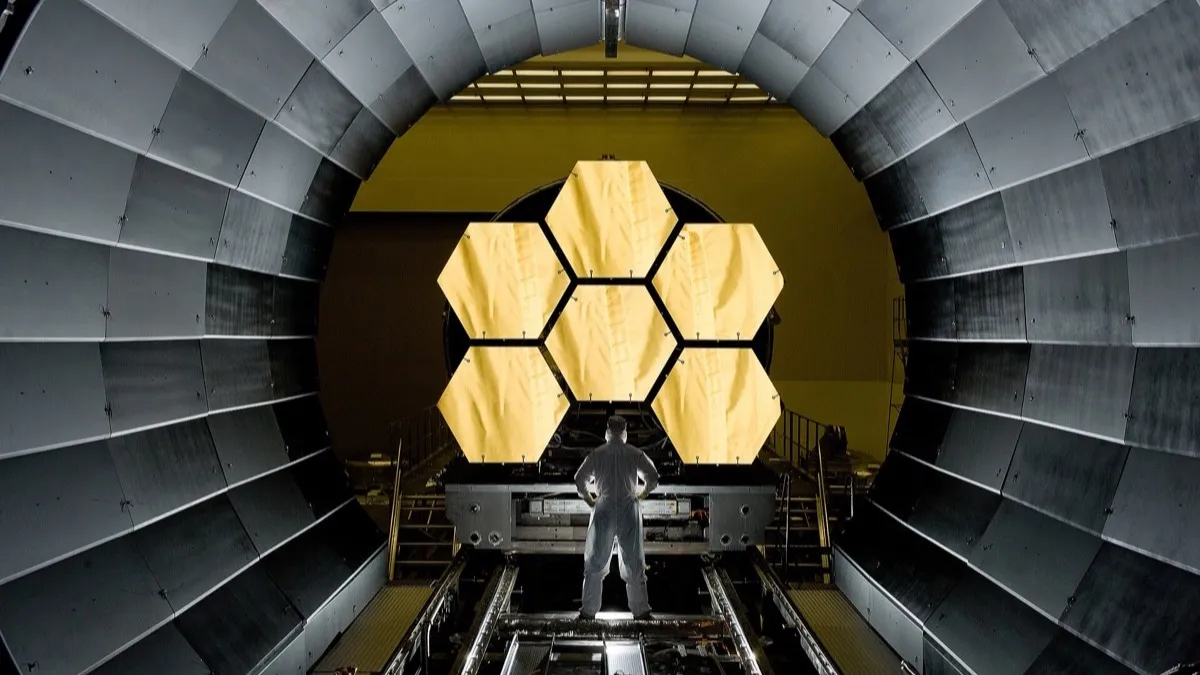
- Cover image: NASA/MSFC/David Higginbotham, Public domain, via Wikimedia Commons
Edited by Rodrigo Cornejo. How we select and verify: who writes these notes.