What happened
- Astronomer Françoise Combes published on 4 November 2026 in PNAS an analysis of 106 galaxy clusters mapped in X-rays under the hypothesis of modified Newtonian dynamics, known as MOND.
- MOND was proposed by Milgrom in 1983 as an alternative to the cold dark matter paradigm and reproduces galactic rotation curves well.
- In galaxy clusters, by contrast, it runs into difficulty: although it reduces the amount of dark matter required, an unidentified mass component is still needed.
- The work explores the hypothesis that this missing mass is baryonic, that is, ordinary matter that does not radiate.
Why it matters
- Dark matter has not been detected as a particle, and that keeps alternatives that modify gravity alive.
- Clusters are the terrain where MOND struggles, so any progress there weighs on the discussion.
- Quantifying how much invisible mass remains and where it concentrates makes it possible to propose observational tests.
The number
A factor of 4 to 10. That is how much MOND reduces the dynamical mass required in these clusters, according to the analysis. The residual missing mass turns out proportional to the total gas mass and roughly half of it.
Context
The method starts from the total mass within Newtonian dynamics, assuming hydrostatic equilibrium and spherical symmetry, derived from the hot intracluster medium that emits in X-rays and makes up most of the visible mass. Then, with the modified Poisson equation, it reconstructs the spatial distribution of the invisible matter within the MOND framework.
Among the baryonic candidates the work mentions are stellar remnants, gas too diffuse to start star formation, and compact, ultra-dense clouds of cold molecular gas with low volume filling factors. In the sample, relaxed systems harbouring cooling flows, called cool-core clusters, show the highest peaks of missing mass. Their density profile shows a pronounced central concentration that is sharply truncated just beyond a core radius of 20 to 30 kiloparsecs.
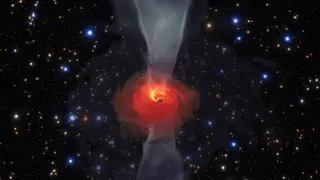
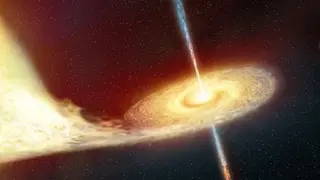
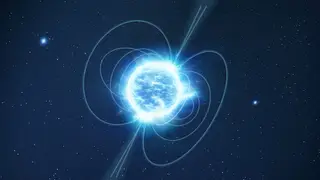
At Mamífero we follow astrophysics. We reported that a calculation showed when a black hole could split in two and that a black hole’s disc inflates and shades itself. Also that harmonic oscillations gave away a magnetar and that Webb measured methane with far more deuterium in 3I/ATLAS.
What’s next
- The baryonic hypothesis predicts concrete structures that could be sought with cold gas observations.
- The sharp truncation of the density profile is a feature other analyses can try to reproduce.
- As long as no dark matter particle appears, comparisons like this will stay relevant.
Bottom line
Changing the law of gravity eases the cluster problem but does not close it. Unseen mass remains, and this work bets it is ordinary matter, only switched off.
Sources
- Combes, F., “Modified Newtonian Dynamics and galaxy clusters”, PNAS, 4 November 2026, DOI 10.1073/pnas.2630246123. This note is based on the paper’s abstract.
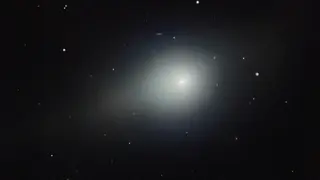
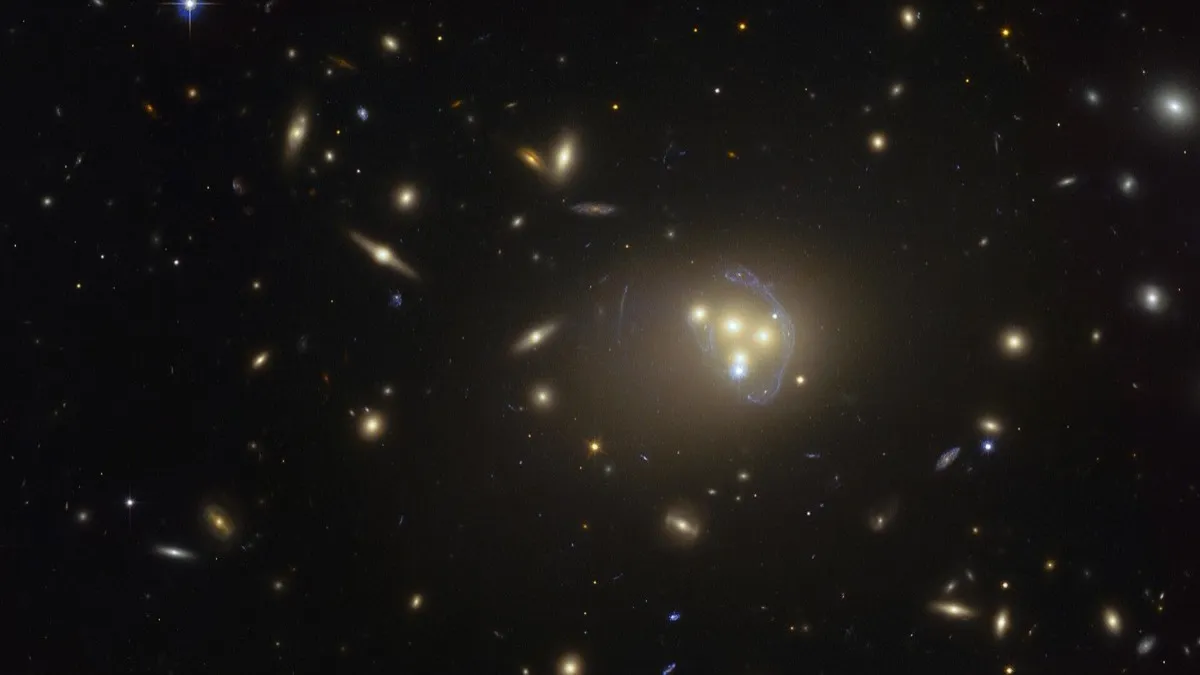
- Cover image: ESO, CC BY 4.0, via Wikimedia Commons
Edited by Rodrigo Cornejo. How we select and verify: who writes these notes.