What happened
- Astronomers from Nanjing University and MIT’s Kavli Institute for Astrophysics published online on 28 October 2026 in Science Advances a reanalysis of the only two short gamma-ray bursts with reported kilohertz oscillations: GRB 910711 and GRB 200415A.
- In both they found signs of harmonic-like organisation around a characteristic frequency near 360 hertz, with features extending above 4 kilohertz.
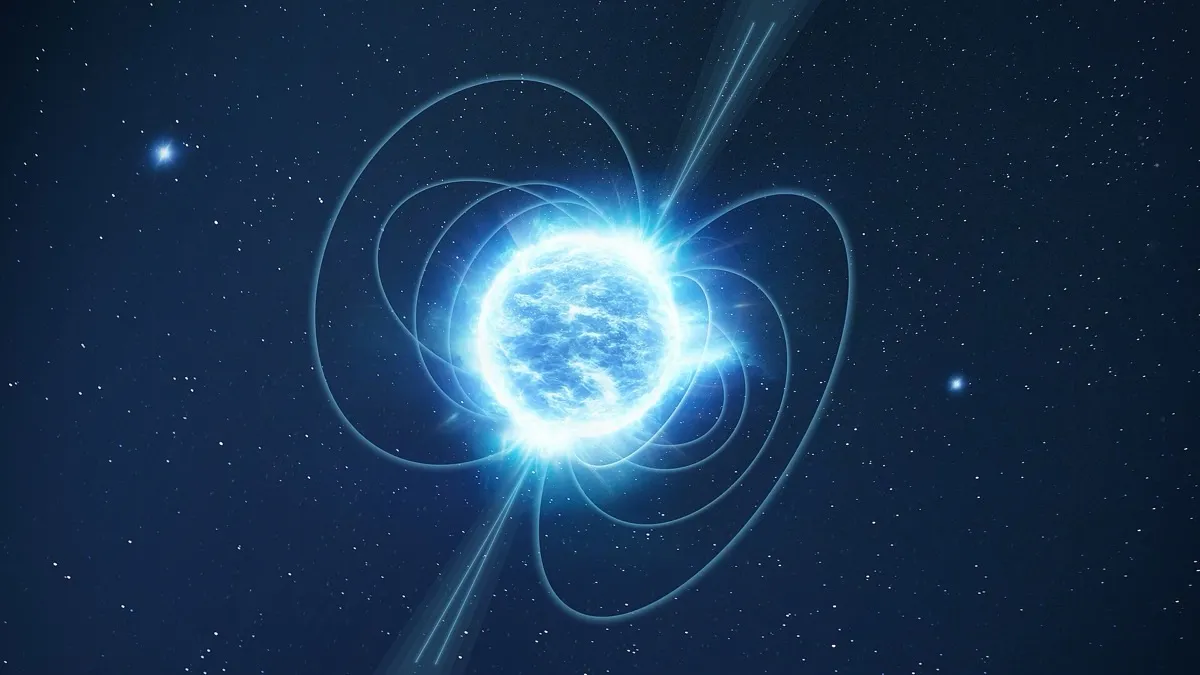
- GRB 200415A had already been confirmed as a giant flare from a magnetar, a neutron star with an extreme magnetic field.
- The temporal and spectral similarity between the two, and the difficulty of explaining those oscillations with a stellar merger, favour the view that GRB 910711, detected in 1991, was also a magnetar giant flare.
Why it matters
- Short gamma-ray bursts are usually attributed to the merger of two neutron stars. But a giant flare from a magnetar in a nearby galaxy can look similar from Earth.
- Telling the two origins apart changes what each event teaches: a merger releases gravitational waves and forges heavy elements; a magnetar flare speaks to the physics of extreme magnetic fields.
- The authors propose the oscillation pattern as an extra tool, alongside spectrum, duration and location, to classify these bursts.
The number
360 Hz. That is the characteristic frequency scale around which the oscillations in the two bursts are organised, according to the reanalysis.
Context
Kilohertz quasi-periodic oscillations have been seen in very few gamma-ray bursts, and their physical origin was unclear. In magnetars, these frequencies match scales relevant to the star’s vibration modes, something a merger does not easily explain.
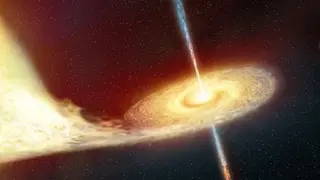
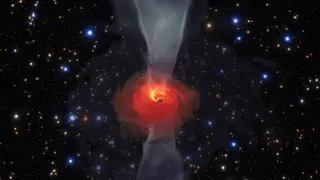
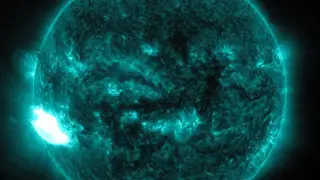
The study revisits data more than three decades old with current methods. Mamífero has covered other extreme phenomena in the cosmos: a black hole disc that puffs up and shadows itself, the calculation of when a black hole could split in two and an X1.5 solar flare with a magnetic field that seemed to weaken. We also follow the interstellar comet 3I/ATLAS, where Webb measured methane with 13 times more deuterium than comet 67P.
What’s next
- The authors speak of “possible” evidence of harmonic organisation. Confirming it will require more bursts with high time-resolution data.
- Gamma-ray telescopes now in operation can look for this pattern in new short bursts and flag magnetar cases sooner.
- If the technique works, some short bursts catalogued as mergers could be reclassified.
Bottom line
A burst recorded in 1991 is getting a possible new identity today. The reanalysis suggests it was not a stellar merger but a magnetar flare. The method, more than the case, is what may help sort the bursts still to come.
Sources
- Chen, R.-C., Gottlieb, O., Zhang, B.-B. et al., “Harmonic brightness oscillations point to magnetar giant flares in rare short gamma-ray bursts”, Science Advances, published online 28 October 2026, DOI 10.1126/sciadv.aee6388. Date and abstract confirmed on Crossref.
- Cover image: ESA, CC BY 4.0, via Wikimedia Commons
Edited by Rodrigo Cornejo. How we select and verify: who writes these notes.