What happened
- NASA announced on November 7, 2026 a package of awards to expand its Moon Base program, at the MAX POWER aerospace expo at Kennedy Space Center.
- It selected eight companies for CLPS 2, the new phase of its commercial lunar delivery service: Blue Origin, Firefly Aerospace, Intuitive Machines, ispace-U.S., Lockheed Martin Space, Northrop Grumman Space Systems, SpaceX and Voyager Technologies.
- It moved forward with PROMISE, a six-wheeled nuclear-powered rover for the lunar south pole.
- It assigned six launch and transport task orders to Arrow Science and Technology, Blue Origin and Impulse Space.
Why it matters
The program aims to establish a sustained presence at the Moon’s south pole, and that needs a regular transport network. CLPS 2 works as a 10-year, multiple-award, indefinite-delivery master contract with a combined maximum value of $10 billion.
NASA also raised the value of the CLPS 1.0 contract from $2.6 billion to $4.2 billion to support initial Moon Base objectives. The original contract remains in place through November 2028, with five more years to complete deliveries through November 2033.
The number
$94 million, plus up to $140 million. That is what NASA awarded Blue Origin as a base contract to deliver PROMISE to the south pole, with an option worth an additional $140 million based on performance. Blue Origin will use its Mark 1 lander to deliver the rover as part of the first phase.
Context
PROMISE (Polar Rover for Observation, Mapping, and In-Situ Exploration) will carry science instruments and technology demonstrations. With nuclear power it can operate through long lunar nights and in permanently shadowed regions thought to harbor ice. It will carry a drill to extract regolith from about one meter down, spectrometers, temperature and radiation sensors, and cameras.
The Jet Propulsion Laboratory (JPL) will build it from spare flight components and engineering test models for the Curiosity and Perseverance rovers, which according to NASA cuts cost and shortens the timeline. NASA is targeting a launch in late 2028 for an 18-month mission.
Administrator Jared Isaacman said Moon Base is being built “mission by mission.” Carlos García-Galán, program manager, said that in the eight months since “Ignition” they have consolidated efforts and awarded new contracts.
At Mamífero we have followed recent space activity. Blue Origin tested Northstar, an engine with half the parts, NASA asked private firms how to extend Hubble’s life, Chang’e-6 suggested KREEP is more spread out on the far side and Xona raised $250 million for orbital navigation.
What’s next
- The eight CLPS 2 companies will be able to compete for future delivery missions.
- PROMISE aims to launch in late 2028 and operate 18 months at the south pole.
- The six launch and transport orders will demonstrate how to move Moon Base cargo to the surface.
Bottom line
The announcement is a logistics piece: contracts, deadlines and providers to take cargo to the Moon on a regular basis. Results will be measured in the missions that reach the surface and the deadlines that are met.
Sources
- NASA, “NASA Awards Moon Base Transportation, Technology, Science Projects”, release 26-095, November 7, 2026, link.
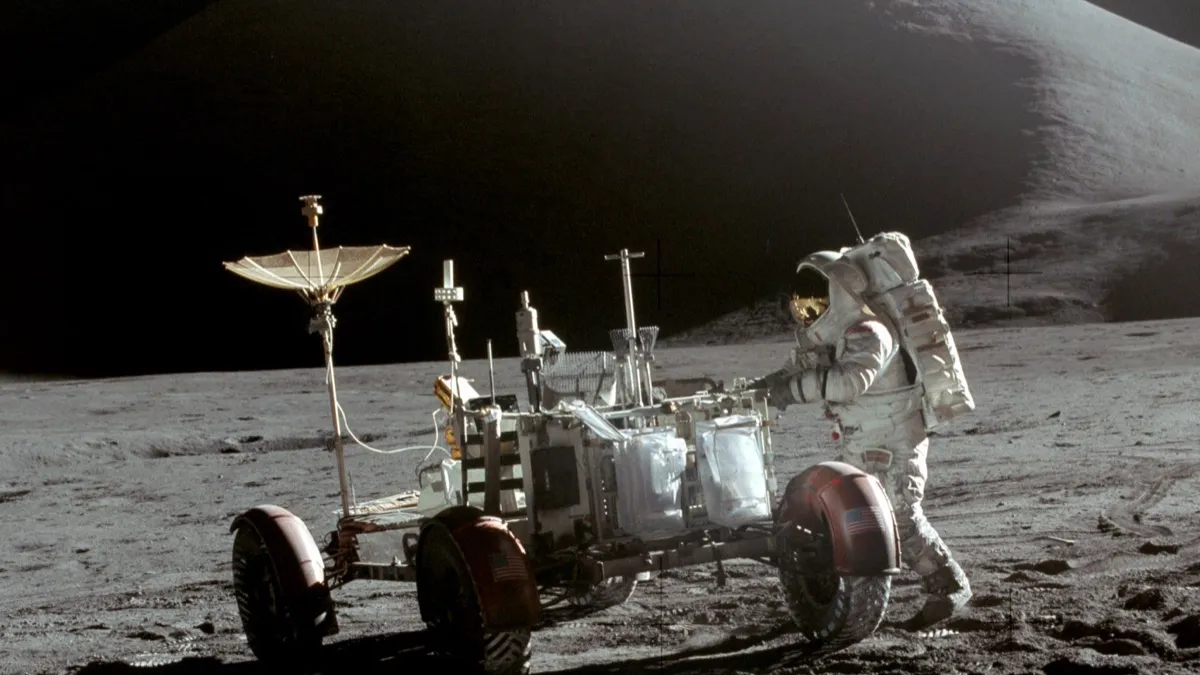
- Cover image: NASA/David Scott, Public domain, via Wikimedia Commons
Edited by Rodrigo Cornejo. How we select and verify: who writes these notes.