What happened
- The new Vera C. Rubin Observatory, on Cerro Pachón in the Chilean Andes, discovered two companions of the Milky Way that had escaped detection.
- The findings come from two studies, one led by a Yale astronomer, per ScienceDaily on 4 November 2026.
- They are satellites: dwarf galaxies and star clusters so poor in stars that they are very hard to detect.
- Astronomers have identified about 65 satellite galaxies around the Milky Way, though some estimates suggest hundreds remain undiscovered.
- The first observations indicate Rubin could play a central role in completing that census.
Why it matters
Counting the Milky Way’s satellites tests how the galaxy formed and what dark matter is. Cosmology models predict a number of dwarf galaxies, and if fewer than expected are found, the explanation may lie in dark matter physics or in how stars formed. The ability to see very faint objects makes Rubin a tool to close the gap between prediction and observation.
The number
65. The satellite galaxies identified so far around the Milky Way; estimates suggest hundreds may be missing.
Context
Rubin is funded by the U.S. National Science Foundation and Department of Energy and sits on Chilean territory. Its first observations already show it can find objects other surveys miss because they are so faint. The text read gives no properties of the two new companions, such as distance, mass or names. Two finds are a start; statistical value will come when dozens accumulate. Related coverage: A physical model of the Webb telescope multiplies its sensitivity up to 15 times, Modified gravity reduces the missing mass in clusters but does not remove it, The Sun may have stripped between 1.7 and 5.2 meters of surface from interstellar comet 3I/ATLAS, A black hole disk puffs up and casts a shadow on itself earlier than expected.
Satellite dwarf galaxies are hard to see because they have few stars and a surface brightness below the sky background. Finding them requires covering large areas with great sensitivity, which is just what Rubin does: it images the southern sky repeatedly, allowing images to be stacked to reveal very faint objects. That is why two early finds, with instruments still being tuned, read as a sign of what is coming.
What’s next
- Rubin will keep sweeping the southern sky and make new discoveries with more data.
- Dark matter models will be tested against the completed satellite census.
- Follow-up with other telescopes is expected to measure distances and composition.
Bottom line
With two new objects the observatory already shows what it can do. The census of the Milky Way’s neighbors is just beginning.
Sources
- ScienceDaily, “Rubin Observatory discovers two hidden companions of the Milky Way. Hundreds more may be waiting”, 4 November 2026, on two studies. Dated before the batch window because it is a niche result; the original papers were not read.
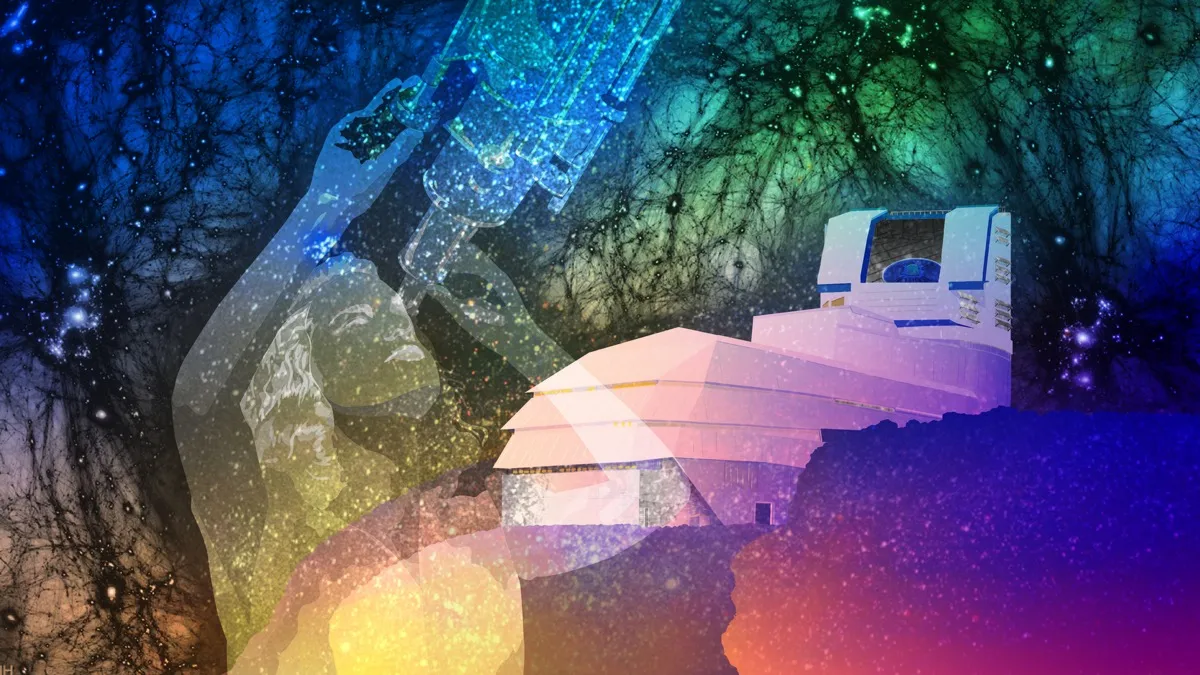
- Cover image: Alice Kitterman & Gavin Flowers/U.S. National Science Foundation, CC BY 4.0, via Wikimedia Commons
Edited by Rodrigo Cornejo. How we select and verify: who writes these notes.