What happened
- The Allen Institute for AI presented on 6 November 2026, on the Hugging Face blog, a framework for creating controlled environments in which to study robot learning. They call them FoundationWorlds.
- The first is ToyBlocks, an open simulation built around a robot arm and blocks on a tabletop. The setting is deliberately simple, but the robot must still reason about how the blocks interact while pushing, flipping and stacking them.
- Each FoundationWorld combines a simulated world with tools for generating tasks and demonstrations automatically, plus metrics for measuring the robot’s behaviour over time.
- The authors want to extend the approach to increasingly complex environments.
Why it matters
- Demonstrations of robots folding laundry or sorting parts tend to be narrow and do not explain what the machine learned or why it fails.
- Scientists usually start with small, controlled environments, such as a petri dish. Robotics lacked one that would let researchers change the training data, repeat a test and trace the cause of an error.
- An environment like this allows concrete questions: how a model improves as data is added, or how best to combine high-level reasoning with fine physical control.
The number
Four requirements. Ai2 designed ToyBlocks to meet at once realistic physics and appearance, automatic generation of tasks and demonstrations at scale, challenges that combine reasoning and control, and measurement of results. According to the authors, a broader domain would make it infeasible to meet them all.
Context
ToyBlocks generates its own demonstrations, that is, recordings of a robot completing tasks in simulation, without the slow teleoperation of a person driving it remotely. Researchers can vary that data, for example with more pushing or flipping demonstrations, and evaluate performance on tasks kept out of training.
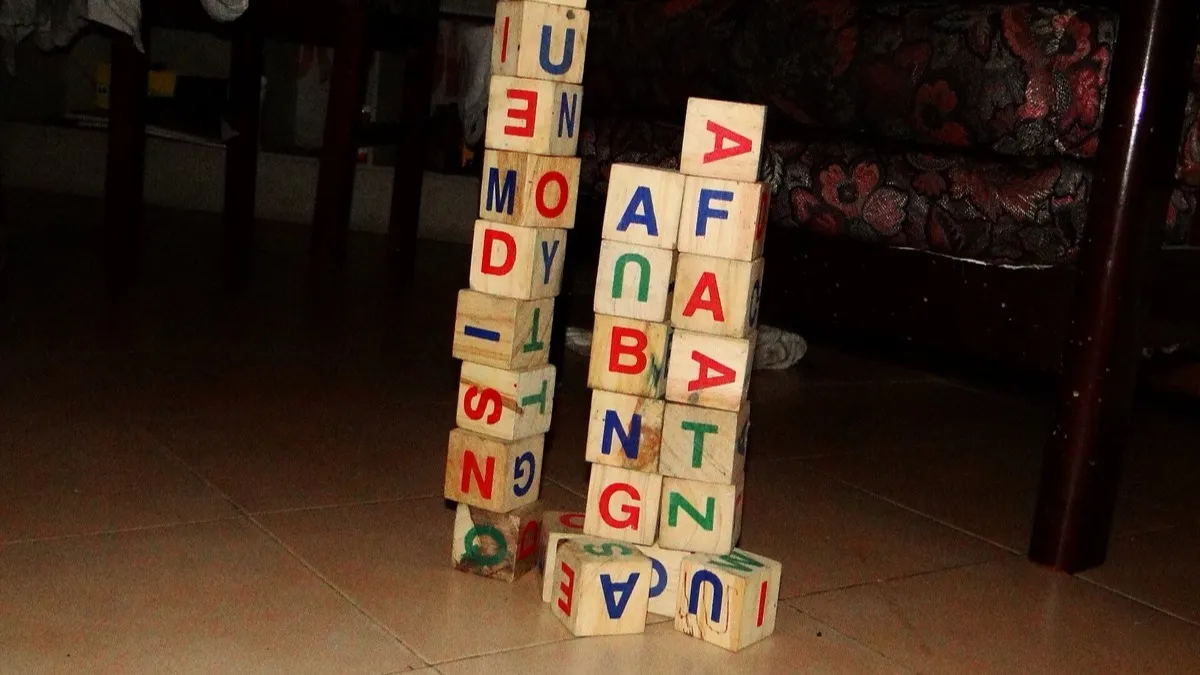
The blocks carry pictures and letters on their faces, so there are search, sorting and arranging tasks. Sometimes the robot must turn a block to see a hidden face. Skills are generated with reinforcement learning and motion planning in Isaac Lab, Nvidia’s open framework, and the policies learn abilities such as pushing or flipping without grasping. A task-and-motion planner chains those skills and produces the data.
All of this happens in simulation. The authors say the simulated arm and blocks behave very similarly to the physical ones, but that correspondence is a claim by the team.
At Mamífero we follow robotics and simulated worlds. We reported that Korea opened a data factory with 12 humanoids and that Mundo turns photos of a room into an explorable world. Also that Rivian bought Third Dimension to recreate real driving scenes and that Nvidia opened four Cosmos 3 models to simulate driving and robots.
What’s next
- Ai2 plans new FoundationWorlds with more complex environments.
- The work builds on its earlier open robot learning projects: MolmoAct 2, MolmoBot and MolmoSpaces.
- It remains to be seen whether what is learned in so narrow a world carries over to real robots.
Bottom line
To understand why a robot fails you need to be able to repeat the experiment. ToyBlocks offers something as modest as an arm and some blocks, but with the advantage that everything can be changed and measured.
Sources
- Allen Institute for AI, “ToyBlocks: A controlled world for robot learning and evaluation”, Hugging Face blog, 6 November 2026, link.
- Cover image: Bobjgalindo, CC BY 4.0, via Wikimedia Commons
Edited by Rodrigo Cornejo. How we select and verify: who writes these notes.