What happened
Boston Dynamics released a video in which its Atlas humanoid moves on wheels. The experiment combined classical model-based control with whole-body reinforcement learning to keep stability across unstructured terrain. The company stresses that a wheeled Atlas is not a product but a research test bed.
Why it matters
Andy Wu, Atlas’s controls engineer, wanted to push the actuation to its limit and understand how the robot adapts to unpredictable environments, where pure models fail. Atlas processes sensor feedback and velocity commands, and adjusts posture and forces to compensate for disturbances. Besides rolling, it does pirouettes and aggressive maneuvers, and switches between fast rolling on flat ground and legged movement over obstacles.
The number
A single custom adapter mounts a standard scooter wheel on Atlas’s ankle actuator; it is the only new part in the whole build.
Context
Wu trained the system in simulation: it learned all the behaviors there and executed them in real life with a precision that surprised him. According to him, converting Atlas’s locomotion style was simple, about as involved as changing a bicycle wheel, because the robot was designed to be produced in volume and be easy to repair. In software, each wheel is modeled as an ankle that can spin continuously. On related topics, Mamífero published Korea opens its first data factory for humanoid robots; A touch-sensing fiber sleeve shows video; Ai2 introduces ToyBlocks, a simulated world for robots and Underdog shows Woof, a 32 MB offline voice model.
What’s next
The next question Wu wants to answer is how the control policy reacts when actuators fail, a key point for safety and for knowing what the system will do in a failure.
Bottom line
The experiment shows a robot that changes how it moves with a minimal adjustment, but it will remain a test as long as the company does not talk about a commercial wheeled model.
Sources
- The Robot Report, article on the Boston Dynamics video (accessed November 9, 2026).
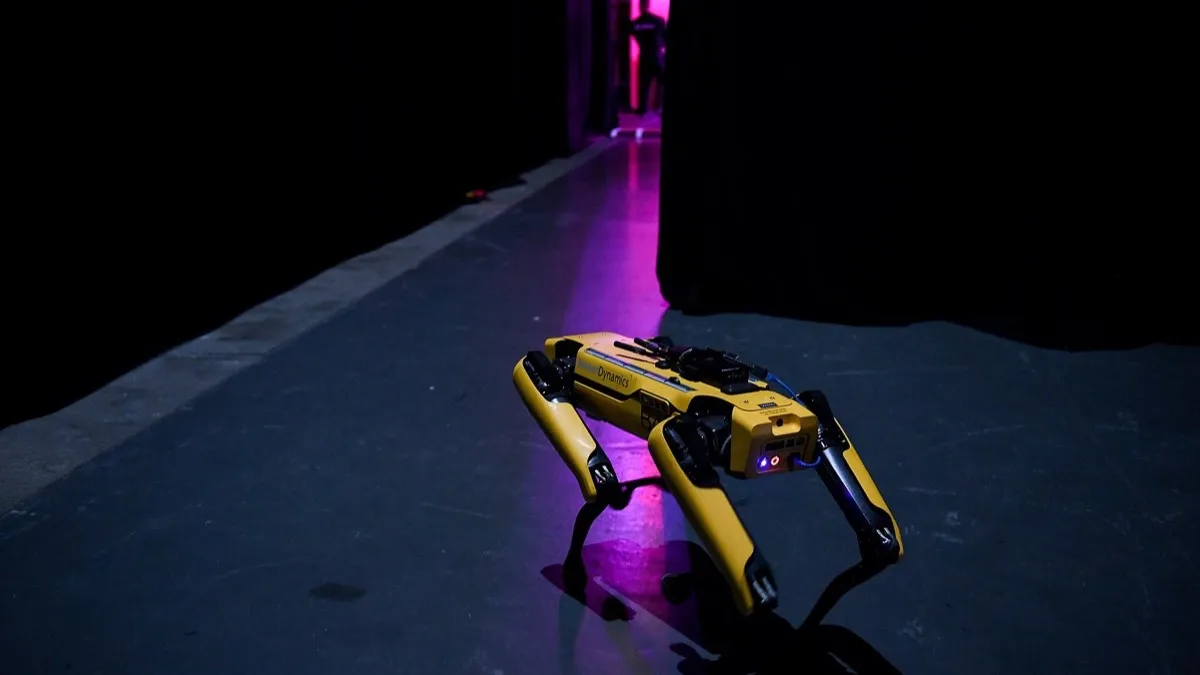
- Cover image: Web Summit, CC BY 2.0, via Wikimedia Commons
Edited by Rodrigo Cornejo. How we select and verify: who writes these notes.