What happened
- Ten researchers, among them McColl, Kroonen, Pinotti and Barrie, published on 4 November 2026 in Nature an analysis of genome-wide data from 4,587 ancient individuals, focused on Bronze Age and Iron Age Europe.
- Celtic languages today survive on Europe’s Atlantic fringes, but during the Iron Age they were spoken across much of the continent. How they reached that distribution is contested.
- The team identified three demographic processes relevant to that spread and tested them against existing archaeological and linguistic models.
- Their conclusion is that the third, a westward expansion from east-central Europe, is the most parsimonious explanation for the spread of Celtic.
Why it matters
- Languages do not travel on their own, but they do not always follow genes either. Setting demographic limits on linguistic models narrows which hypotheses remain standing.
- The debate had run for decades between two families of proposals, with different homelands and routes.
- The study is explicit about its caution: it delimits plausible scenarios, it does not prove which one happened.
The number
4,587 individuals. That is the number of ancient people whose genome-wide data were analyzed, a scale that allows population movements to be tracked rather than isolated cases.
Context
The first process they describe is the arrival of Steppe-related ancestry with Bell Beaker-associated groups, after about 4,400 years before present, across the region where Celtic and related languages were later spoken. The second is a movement from southwestern Europe into Britain during the Bronze Age, between 3,800 and 3,200 years before present, consistent with scenarios placing the formation of Celtic along the Atlantic façade.
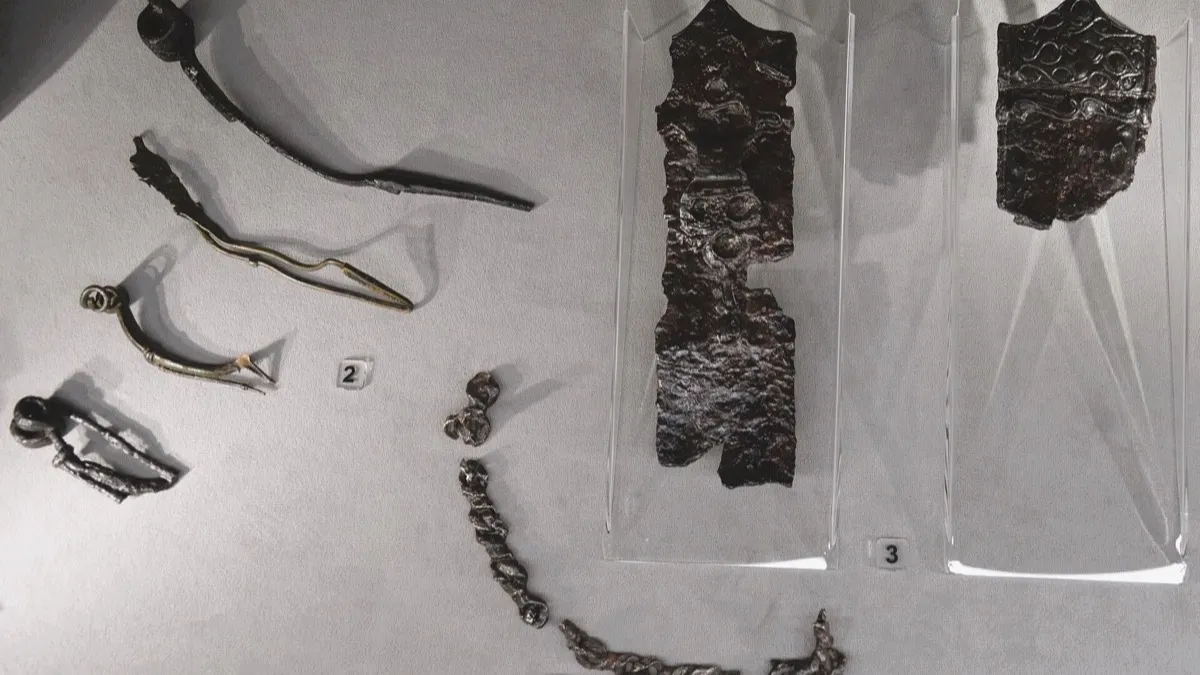
The third, the one the authors consider most parsimonious, is the westward expansion of ancestry linked to Late Bronze Age Knovíz–Urnfield populations, between 3,200 and 2,800 years before present. It affected France, the British Isles, northeastern Iberia and Italy, and is later associated with the Hallstatt and La Tène contexts of the Iron Age.
At Mamífero we follow the genetics of ancient populations. We reported that proteins identified two Xujiayao fossils as Denisovan and that a woman from Isturitz left a genome showing European exchange. Also that an ancient retrovirus switched off in chimpanzees a gene humans use and that a lack of knappable stone kept early humans away from the Rub al-Khali.
What’s next
- Linguistic models will have to be measured against these demographic limits.
- More samples from east-central Europe would sharpen the route and the dates.
- The authors themselves warn that a language shift need not involve genetic change, so the discussion stays open.
Bottom line
Archaeogenetics does not settle what was spoken in a village, but it does show which populations moved and when. With those data, one of the proposed routes for Celtic stands better than the others.
Sources
- McColl, Kroonen, Pinotti, Barrie et al., “Tracing the spread of Celtic languages using ancient genomics”, Nature, 4 November 2026, DOI 10.1038/s41586-026-11198-9. This note is based on the paper’s abstract.
- Cover image: Silar, CC BY-SA 4.0, via Wikimedia Commons
Edited by Rodrigo Cornejo. How we select and verify: who writes these notes.