What happened
- Elethron, an advanced materials company based in London, announced it will set up aluminium nitride (AlN) substrate manufacturing in the United Kingdom. Semiconductor Today published it on 3 November 2026.
- It will start with 2-inch wafers for evaluation, device fabrication trials and industrial qualification.
- It has already begun installing its first crystal-growth capability. It will supply small batches to epitaxial foundries, semiconductor manufacturers and laboratories in the UK and Europe.
- In parallel it is launching AlN4RF, the first in a series of industry co-development programmes, aimed at precision microwave and high-power radio frequency for radar, satellite communications and advanced radio.
Why it matters
- Aluminium nitride combines an ultra-wide bandgap, high thermal conductivity, good electron mobility and deep-ultraviolet transparency. That makes it attractive for power electronics, advanced radio frequency and optoelectronics in extreme environments.
- It also serves as a native substrate for aluminium-rich nitride structures used in emerging devices.
- “The UK relies on foreign and challenged supply chains for wide-bandgap materials, exposing domestic industry to geopolitical and supply risks,” said Hamid Soorghali, founder and chief executive.
The number
2 inches. That is the diameter of the first aluminium nitride wafers Elethron will make, with a planned path to 4-inch wafers.
Context
The UK has a strong base in compound semiconductor research, epitaxy, device fabrication and metrology, according to the company, but no domestic source of AlN substrates. Elethron says it will work on improving wafer quality and yield, lowering production costs and building a reliable supply. “Our immediate priority is to develop AlN substrates that manufacturers can process, test and qualify in their devices,” Soorghali said. The company presents the substrates as the base of a broader portfolio of materials for high-temperature, high-power and radiation-tolerant electronics.
At Mamífero we follow materials for electronics and photonics. We reported that quantum dot photodiodes matched InGaAs in the infrared and that AIST counts photons by the magnetic flux quanta they leave in a superconductor. In layered materials, WS₂ layers with the same twist respond to polarised light, and Smith-Purcell radiation hid a chirality that reveals a silicon grating.
What’s next
- Elethron will deliver small batches of 2-inch wafers to partners for epitaxial growth and fabrication trials.
- It is preparing demonstrators with industrial partners to take AlN from initial evaluation to device fabrication.
- The next technical goal is 4-inch wafer production.
Bottom line
Elethron starts with small wafers and short batches, but it targets a deeper problem: depending on foreign suppliers for a material that sets the performance of radar and communications. Qualification by manufacturers will show whether the plan works.
Sources
- Semiconductor Today, “Elethron to build UK AlN substrate manufacturing capability”, 3 November 2026, semiconductor-today.com. It reproduces Elethron’s announcement.
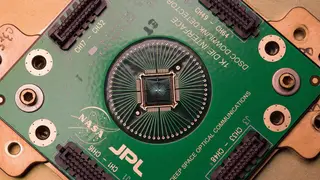
- Cover image: Evavilova, CC BY-SA 4.0, via Wikimedia Commons
Edited by Rodrigo Cornejo. How we select and verify: who writes these notes.