What happened
- Fourteen researchers, with Moretti, Fripiat, Hain and Luciani among the authors, published on 6 November 2026 in Nature Geoscience a study on the causes of elevated CO₂ in the early Eocene.
- The Early Eocene Climatic Optimum, between 53 and 49 million years ago, was one of the times with the highest temperatures and CO₂ concentrations of the last 66 million years. The causes of that high CO₂ are unclear.
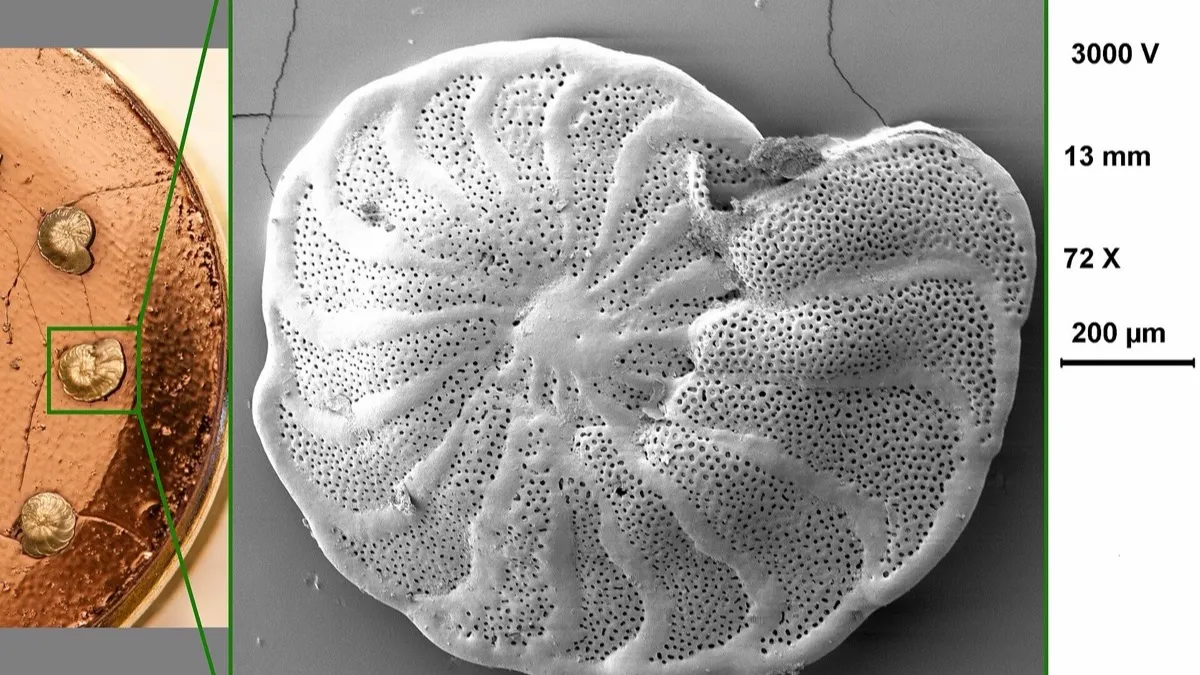
- The team measured nitrogen isotopes bound to foraminifera shells, microscopic marine organisms whose shells are preserved in sediment.
- The data show higher nitrate concentrations at the surface of the Southern Ocean, which indicates less efficient biological sequestration of carbon during the peak of that interval.
Why it matters
- In recent ice age cycles, atmospheric CO₂ appears to have been largely controlled by the build-up and release of carbon from the Southern Ocean. The study tests whether that mechanism also operated much earlier.
- Understanding where so much CO₂ came from in a warm world helps calibrate how much the climate system responds.
- The result gives the ocean a principal role, and not only volcanoes or rock weathering.
The number
At least half. According to the authors, the change in biological pump efficiency in the Southern Ocean can explain at least half of the atmospheric CO₂ increase observed during the Early Eocene Climatic Optimum.
Context
The biological pump is the process by which plankton fix carbon at the surface and sink it towards the bottom. If nutrients such as nitrate are not fully consumed at the surface, the pump works worse and carbon from the deep sea returns more easily to the atmosphere.
That transfer would have been amplified by the low chemical buffering capacity of Eocene seawater, due to its lower pH and a high calcium concentration. The authors add that the low weathering of silicate rocks, proposed earlier for that time, may have weakened the weathering thermostat, so the ocean weighed more.
The results rest on foraminifera data and on carbon-balance reasoning for a remote epoch. The abstract gives neither the location of the sediments nor the number of samples, so the strength of the reconstruction has to be judged from the full paper.
At Mamífero we follow carbon in seas and soils. We reported that above 2 °C the Earth would keep warming even with zero emissions and that seagrass meadows bury less carbon than estimated. Also that Antarctic ice loss is salting a layer of the ocean and that future heatwaves will pile up several times more heat than today’s.
What’s next
- Measuring more Southern Ocean sites would confirm whether the pattern was regional or global.
- Carbon cycle models can incorporate this mechanism for warm epochs.
- How much other CO₂ sources contributed to the remaining half of the rise has yet to be pinned down.
Bottom line
The deep sea holds a lot of carbon and, when the biological pump falters, it returns it to the air. Fifty million years ago, that fault would have been enough to explain much of the heat.
Sources
- Moretti, Fripiat, Hain, Luciani et al., “Elevated early Eocene atmospheric CO2 tied to reduced Southern Ocean biological pump efficiency”, Nature Geoscience, 6 November 2026, DOI 10.1038/s41561-026-02142-7. This note is based on the paper’s abstract.
- Cover image: Louis-F. Stahl and Susanne Schneidereit, CC BY-SA 3.0 de, via Wikimedia Commons
Edited by Rodrigo Cornejo. How we select and verify: who writes these notes.