What happened
- A team of 15 researchers published on 3 November 2026 in Nature Climate Change a study of what happens to global temperature when human CO₂ emissions stop.
- That subsequent temperature change is called the zero emissions commitment. It is central to calculating carbon budgets and to knowing whether warming can be reversed.
- Using the UK Earth System Model (UKESM1.2), the authors simulated emissions stopping at different warming levels, between 1.5 and 5 degrees.
- Up to about 2 degrees, the commitment stays close to zero: temperature stabilises. Above that, it turns positive and reaches 0.4 to 0.6 degrees of extra warming after about 150 years.
Why it matters
- Many carbon budget calculations assume that once emissions reach zero, temperature stops rising. The study shows that depends on how much the planet has already warmed.
- The higher the warming peak, the harder it becomes to stabilise or reverse temperature.
- That limits the option of overshooting a temperature target and coming back later, a scenario that appears in several mitigation pathways.
The number
0.4 to 0.6 °C. That is the additional warming the model projects about 150 years after reaching zero emissions, when prior warming exceeds 2 degrees.
Context
The authors identify the mechanism. Greater warming brings a larger radiative imbalance, meaning more energy coming into the system than leaving it. Carbon sinks also weaken: land carbon uptake saturates and the drawdown of atmospheric CO₂ has less radiative effect when the background concentration is higher. Together, these mean that after emissions stop the planet keeps warming instead of stabilising.
The result comes from a single Earth system model. Other models may give different values, and comparing across them is the usual way to test how robust such a finding is.
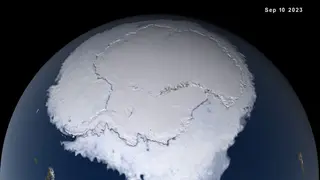
At Mamífero we follow how the climate system responds. We reported that Antarctic sea ice reached 17.59 million km² in 2026 and that NASA adjusted its Thwaites model and its contribution to sea level could double. Also that a Baffin ice cap was regrowing towards a new ice age until heat stopped it and that extreme rainfall in southern Africa would double in frequency.
What’s next
- Other groups can repeat the emissions-cessation experiments with their own models to test the 2-degree threshold.
- The finding affects how remaining carbon budgets are calculated for high warming levels.
- It also bears on the assessment of scenarios that overshoot a target and then try to bring temperature down with CO₂ removal.
Bottom line
Reaching zero emissions halts warming only if it comes in time. According to this model, beyond 2 degrees the planet keeps rising on its own for centuries, and every extra tenth of a degree at the peak makes going back harder.
Sources
- Gibbs, L., Jones, C., Jones, C. et al., “Zero emissions commitment depends on warming level”, Nature Climate Change, 3 November 2026, DOI 10.1038/s41558-026-02776-w. This note is based on the paper’s abstract.
- Cover image: Earth Science and Remote Sensing Unit, NASA Johnson Space Center, public domain, via Wikimedia Commons
Edited by Rodrigo Cornejo. How we select and verify: who writes these notes.