What happened
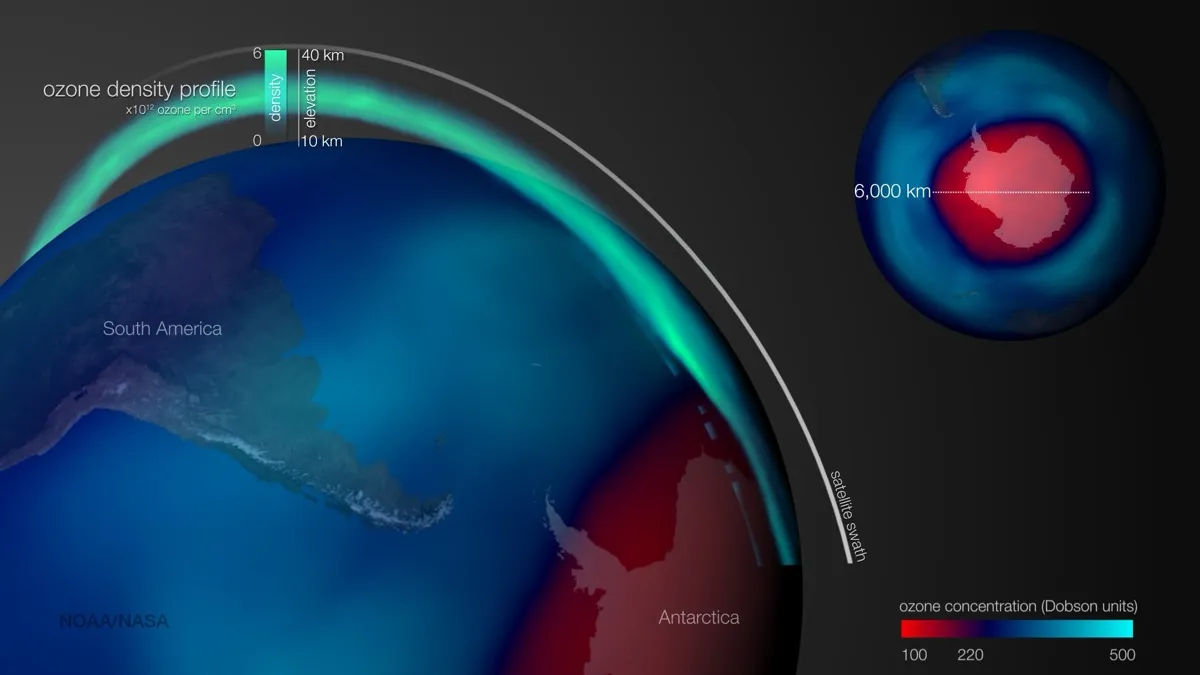
- NASA’s Earth Observatory published on November 9, 2026 the update on the Antarctic ozone hole: it reached its 2026 maximum on September 18.
- Measured by its mean size between September 7 and October 13, the peak depletion season, it was the seventh largest in 48 years of monitoring.
- It was not as deep as other large holes on record.
- The 2026 measurements come from the OMPS instrument on the NOAA-20 satellite.
Why it matters
The ozone layer absorbs ultraviolet light that damages the DNA of plants and animals, including humans, and causes sunburn and skin cancer. A wide hole in one year does not contradict long-term recovery: year-to-year variations depend on stratospheric temperature and circulation.
In 2026 an unusually strong Antarctic polar vortex created ideal conditions for ozone depletion over a large area. Colder conditions yield a larger hole and lower values in its core.
The number
220 Dobson units. That is the threshold scientists use to define the hole: the area where ozone concentration drops below that value, which had not been observed before 1979. The word “hole” is a metaphor, as no place is empty of ozone.
Context
In 1985, British Antarctic Survey scientists reported from Halley station that the layer was thinning each spring over Antarctica. NASA satellites then showed the continental scale of the phenomenon. In 1979 the maximum depth was 194 Dobson units; it fell to 124 in 1985 and dropped below 100 for the first time in 1991. The lowest reading was 73 units on September 30, 1994.
Records in depth and area never occur in the same year: the largest hole came in 2006. Since the early 2000s annual holes have roughly stabilized, according to NASA. Chlorofluorocarbons, used since the 1930s in refrigerators and aerosols, caused the problem: they circulate for decades without degrading and, on reaching the stratosphere, ultraviolet light breaks them apart.
At Mamífero we have followed climate and carbon research. The Southern Ocean may have released CO₂ and explain half the Eocene rise, a nickel catalyst reduces dilute CO₂ from flue gases, glaciers ending in water lose more than half their ice and a single number is proposed to measure the permanence risk of removed carbon.
What’s next
- NASA will keep measuring the hole every season with its satellite instruments.
- Annual variations will keep depending on stratospheric weather.
- The 48-year series allows each year to be compared with earlier ones.
Bottom line
A seventh place in size does not change the trend, but it is a reminder that each season depends on stratospheric cold. NASA’s series lets those swings be separated from the long-term path.
Sources
- NASA Earth Observatory, “Ozone Hole Reaches Its 2026 Maximum”, November 9, 2026, link.
- Cover image: NOAASatellites, Public domain, via Wikimedia Commons
Edited by Rodrigo Cornejo. How we select and verify: who writes these notes.