What happened
- A team led by Yasir A. Mohamed, Hana A. Mohammed and Mohamed A. Hassan published on November 7, 2026 in Communications Earth & Environment a study of the first filling (2020 to 2024) of Ethiopia’s Grand Renaissance Dam.
- The reservoir reached 95% of capacity by the end of hydrological year 2024-2025 without major downstream impacts, but the filling remains highly contentious.
- Because there was no data exchange, the authors estimated river inflows with a hydrological model, reconstructed the filling from satellite observations and evaluated the impacts with a river basin simulation model.
- This note is based on the paper’s abstract.
Why it matters
The study shows that the operation of a reservoir shared by several countries can be reconstructed and evaluated using only independent public data. In a basin with no formal data exchange, that gives a common basis for discussing what happened.
For downstream countries, the question is how much the filling affected them. The study answers with numbers for Sudan and Egypt, though with models and not with each country’s own measurements.
The number
3,000 GWh versus 12,000 GWh. That is actual hydropower generation between 2020 and 2024 compared with the planned scenario. The difference is mainly due to delayed turbine commissioning.
Context
According to the abstract, exceptionally wet years and mitigation measures largely avoided downstream impacts. Generation at Roseires in Sudan rose slightly, and Merowe’s remained largely unchanged. Floodplain agriculture in Sudan declined by 4% to 50%.
Levels at the High Aswan Dam in Egypt stayed high and its generation was comparable thanks to high inflows and mitigation measures.
The study compares planned and actual trajectories, so its results depend on the quality of the models and satellite estimates. The authors present the framework as a way to evaluate transboundary reservoir operation when formal data exchange is lacking. The full text was not reviewed.
At Mamífero we have followed water and climate research in Africa. Africa demands 347 km³ of water a year and irrigation takes almost two thirds, southern Africa’s extreme rains would double, without stone to carve, early humans avoided the Rub al-Khali despite water and glaciers ending in water lose more than half their ice.
What’s next
- Countries in the basin could use a framework like this to discuss the dam’s future operation.
- It remains to be seen whether data exchange will allow the model to be checked against real measurements.
- Dry years will test the mitigation measures that worked in wet years.
Bottom line
The study does not settle the political dispute, but it contributes an independent account of the first filling. Its key result is that rains and mitigation avoided larger harm, although Sudan’s floodplain agriculture did fall.
Sources
- Mohamed, Y. A., Mohammed, H. A., Hassan, M. A. et al., “The first filling of the Grand Ethiopian Renaissance Dam (GERD): hydrological and operational insights”, Communications Earth & Environment, November 7, 2026, DOI 10.1038/s43247-026-04201-8, link. The note is based on the paper’s abstract.
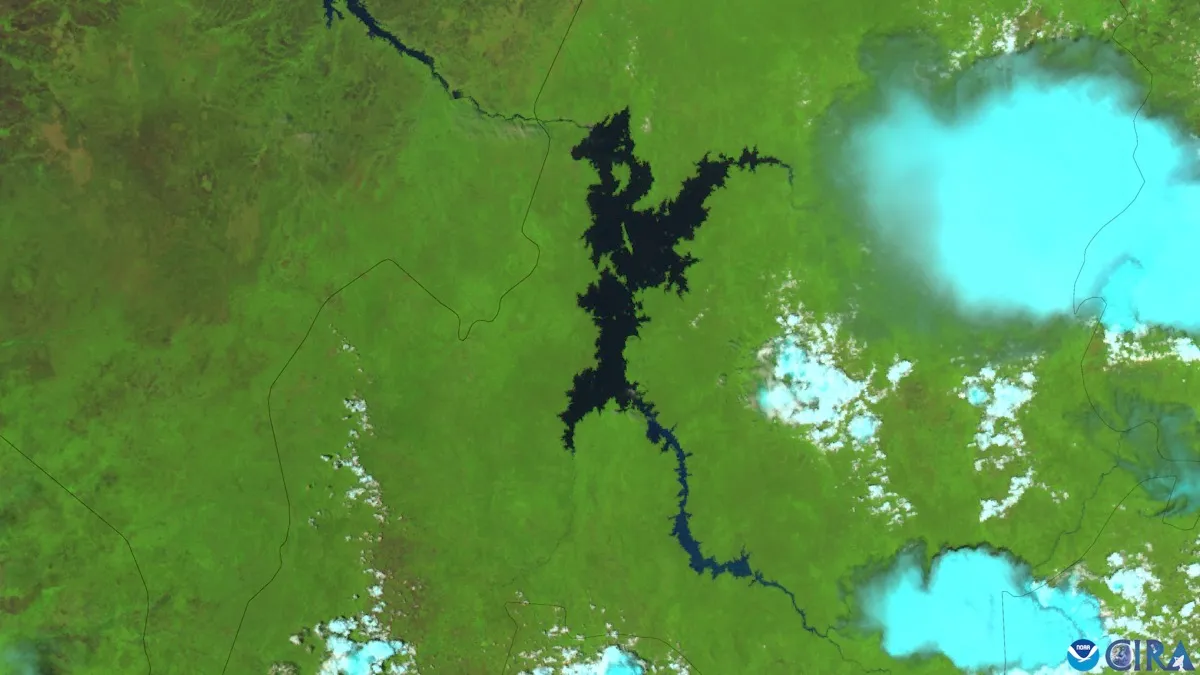
- Cover image: JPSS imagery: CSU/CIRA & NOAA/NESDIS, Public domain, via Wikimedia Commons
Edited by Rodrigo Cornejo. How we select and verify: who writes these notes.