What happened
A robot assembled part of a structure in space for the first time without astronauts. The system was developed by researchers at the California Institute of Technology (Caltech) with DARPA funding, within the NOM4D program, which explores how to manufacture and assemble huge structures directly in orbit. An automatic arm takes tubes and joints from nearby dispensers and joins them into repeating sections that form a truss.
Why it matters
Sergio Pellegrino, a Caltech professor and JPL scientist who leads the ASTRA demonstration, said it is the first time a structure has been built autonomously in space. The technique could change how very large spacecraft and telescopes are built, which today must fit folded into a rocket and then deploy.
The number
The robot spent six months in orbit trying to build a reflector antenna 1.4 meters across.
Context
The design combines composite fiber tubes, aluminum connectors and a lightweight reflective surface made of Kapton, a polymer common on spacecraft. DARPA compares the process to building with K’Nex or Tinkertoy. The team ran into technical and scheduling difficulties that kept it from finishing the whole antenna, but the robot did assemble a first section. It is the third stage of the program: in the first two, Caltech developed the concept, the engineering design and its verification in laboratories on Earth. On related topics, Mamífero published Flexell Space to test solar cells in orbit with Satoro; Ai2 introduces ToyBlocks, a simulated world for robots; China blocks SoftBank’s purchase of ABB Robotics and Nvidia opens four Cosmos 3 simulation models.
What’s next
Researchers believe the same approach could support much larger structures with large reflective surfaces. To get there they need to complete the assembly and repeat it with more pieces.
Bottom line
Although the antenna was left incomplete, the demonstration showed that building in space with robots is possible.
Sources
- ScienceDaily, summary of the Caltech statement (accessed November 9, 2026).
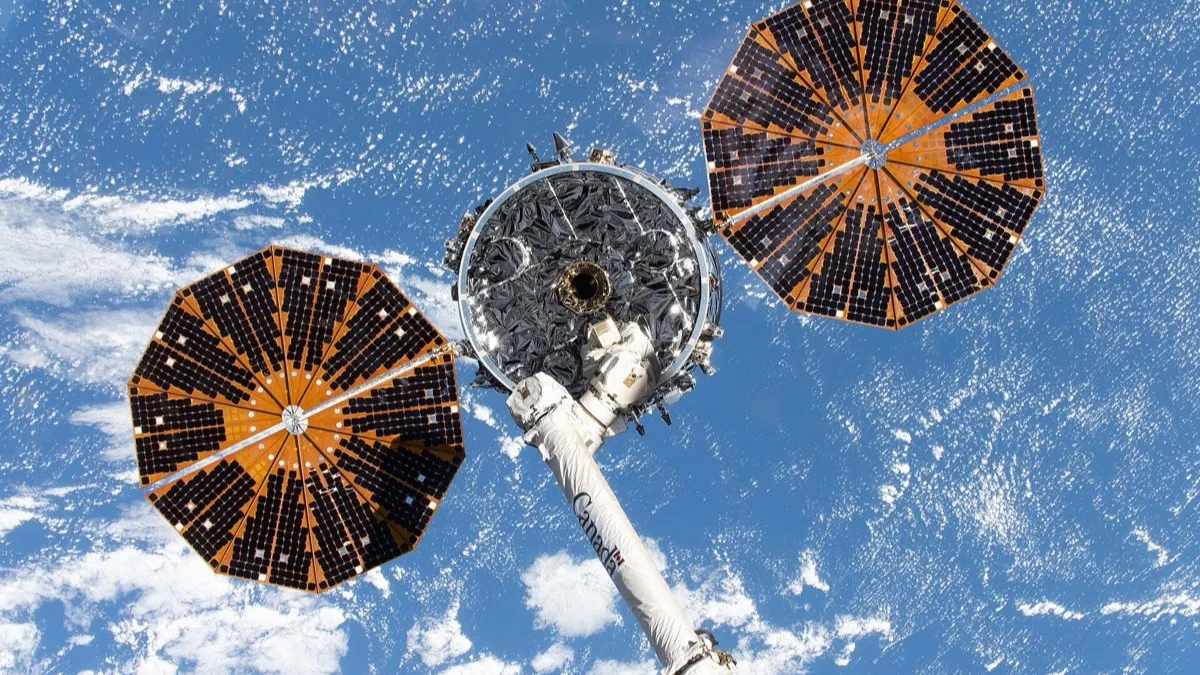
- Cover image: NASA Johnson Space Center, Public domain, via Wikimedia Commons
Edited by Rodrigo Cornejo. How we select and verify: who writes these notes.